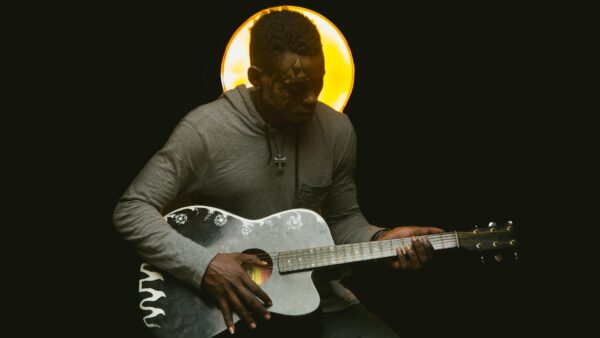

Listen to the first thirty seconds of O'Kenneth's "DANSO" and you will understand why he matters. There is no beat drop, no attempt to make you move. Just his voice, alone, describing the weight of betrayal with the precision of someone who has lived it. The production comes in quietly, like a thought forming, and by the time he finishes the first verse you realise this is not the kind of rap that tries to convince you of anything. It assumes you already know what he is talking about.
O'Kenneth is a Yoruba-language rapper working out of Lagos, and if you have not heard his name yet, it is because he has spent the last few years building something deliberately small and uncompromising. He makes music about the things that kill you slowly. His recent tracks, "DANSO" and "Ototrobonsu," both released in 2025, are structured like confessions, each one moving through layers of pain, betrayal, loneliness, and spiritual searching. The beats are minimal. The production leans toward the empty spaces. His voice carries the weight.
What makes O'Kenneth distinct in a rap landscape that is increasingly built for streaming playlists and radio rotation is his commitment to specificity. He is not rapping about money or status or women in the abstract. He is rapping about the particular kind of numbness that comes from being let down by people who were supposed to stay. In "Ototrobonsu," which translates roughly to exploring the cycles of struggle, he moves between Yoruba and English in a way that feels natural rather than performed. The code-switching is not for effect. It is how the thought moves, how the pain finds language.
There is a generation of young Nigerians who grew up on American hip-hop but who are now searching for something rooted in their own context, their own language, their own way of speaking about hardship. O'Kenneth is one of the few rappers giving them that. His production choices reflect this too. The beats do not sample from the American canon. They are built from a different sonic vocabulary, something that sits between Afrobeats and traditional Yoruba rhythmic patterns, but filtered through a contemporary rap sensibility. The result feels both immediate and timeless in a way that suggests real thought has gone into every choice.
His emergence in 2025 comes at a moment when Nigerian music is becoming more regionally diverse. Afrobeats dominated the conversation for years, but there is now space for voices working in different genres and languages. O'Kenneth is not trying to be heard on TikTok. He is making music for the moment when someone is alone at night, thinking about who they can trust, wondering if they are the problem. That specificity of purpose is rare. Most artists are trying to be heard by everyone. He is trying to be heard by people who need to hear him.
What comes next for him is unclear, and perhaps that is the point. He is building an audience person by person, listener by listener, someone who shares a song with a friend and says, "You need to hear this." That is how real music spreads, not through algorithm optimization but through genuine recognition. "DANSO" and "Ototrobonsu" have attracted attention in music circles and among people who follow Nigerian hip-hop closely, but he has not yet reached the level of mainstream recognition where every move is scrutinized and every next project becomes a media event. That moment may come. Or he may choose to stay in the space he has created, where honesty is still possible, where a song can be about something real without having to perform for the internet.
OduDiscover is OduNews’s spotlight on Nigeria’s next generation of talent.