
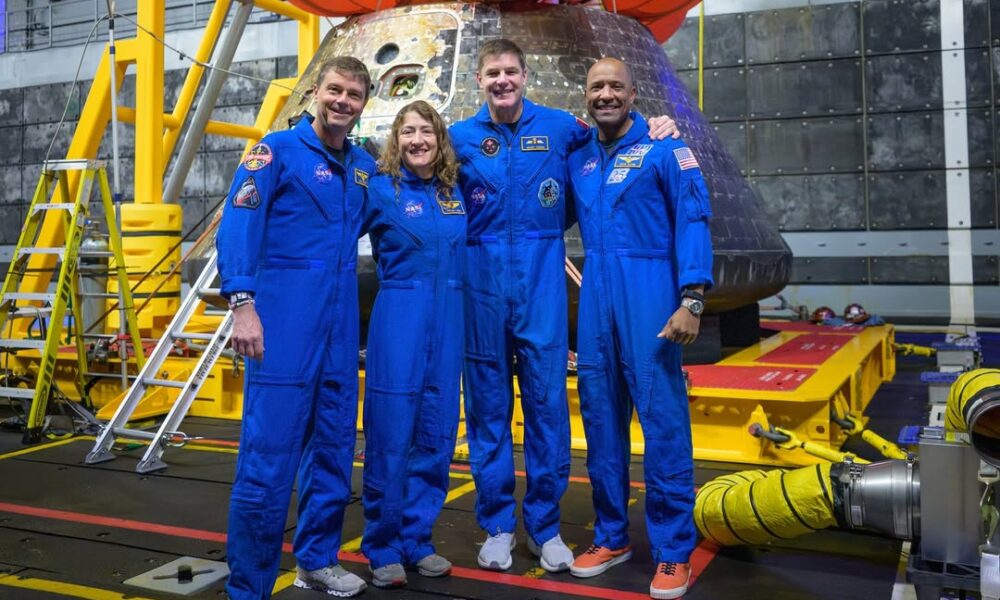
Four astronauts landed in the Pacific Ocean on 10 April 2026, concluding a nearly ten-day journey around the Moon that took them farther from Earth than any humans in history. NASA astronauts Reid Wiseman, Victor Glover, and Christina Koch, along with Canadian Space Agency astronaut Jeremy Hansen, splashed down after a perilous re-entry through Earth's atmosphere at speeds reaching 25,000 miles per hour.
The Artemis II mission launched on 1 April 2026 aboard the Orion spacecraft, which the crew named Integrity. During their journey, they achieved a historic milestone on 6 April, traveling 252,756 miles from Earth, breaking the record for the farthest distance humans have ever ventured from home. The crew spent nearly ten days in space before beginning their descent.
The journey home proved as challenging as the voyage outward. On their final day in space, the astronauts woke approximately 61,326 miles from Earth. They faced a series of critical return trajectory correction burns, precise engine firings designed to lock Orion onto the exact path needed for safe re-entry. These maneuvers essentially adjusted the spacecraft's aim mid-flight, correcting course for a celestial target moving at tens of thousands of miles per hour.
Re-entry from the Moon differs fundamentally from returning from the International Space Station. The Orion spacecraft encountered Earth's atmosphere at 400,000 feet above the surface while traveling 35 times the speed of sound. At this velocity and angle, the spacecraft experienced temperatures reaching 5,000 degrees Fahrenheit, hotter than anything found on Earth's surface.
The Orion capsule relies on a specially designed heat shield fitted to its base to survive this extreme environment. The heat shield absorbs and deflects the intense thermal energy generated during re-entry. Engineers identified known design flaws in Orion's heat shield during the uncrewed Artemis I mission, making the Artemis II re-entry one of the most closely monitored moments of the entire flight. Mission Control in Houston and observers worldwide watched intently as the spacecraft descended through the atmosphere.
A planned six-minute communications blackout tested the nerves of flight controllers and mission managers. As Orion descended through approximately 400,000 feet, intense heat created a layer of charged particles, or plasma, around the capsule. This plasma completely blocked all radio signals between the spacecraft and Mission Control. For those six minutes, neither the crew nor Mission Control could communicate with each other. Everyone involved in the mission simply had to wait for confirmation that the crew had survived.
When radio signals returned, they confirmed what everyone hoped for. The crew emerged safely from the blackout phase. The spacecraft continued its descent, with parachutes deploying to slow Orion from approximately 25,000 miles per hour to just 20 miles per hour before splashdown in the Pacific Ocean.
Christina Koch celebrated with members of the Johnson Space Center recovery team after the mission concluded. The successful return of Artemis II marks another milestone for NASA's lunar exploration program and sets the stage for Artemis III, which will attempt to land astronauts on the Moon's surface. The next phases of the Artemis program will build directly on the systems and procedures proven during Artemis II's successful completion.